Retinol vs. Retinal: The science behind cellular conversion
Within the retinoid family, two active ingredients dominate the "healthy aging" market: retinol and retinaldehyde (often called retinal). Although they share a common origin (Vitamin A), their effectiveness on the skin relies on a precise biological mechanism: the conversion cascade.
1. The retinoid cascade: A matter of metabolism
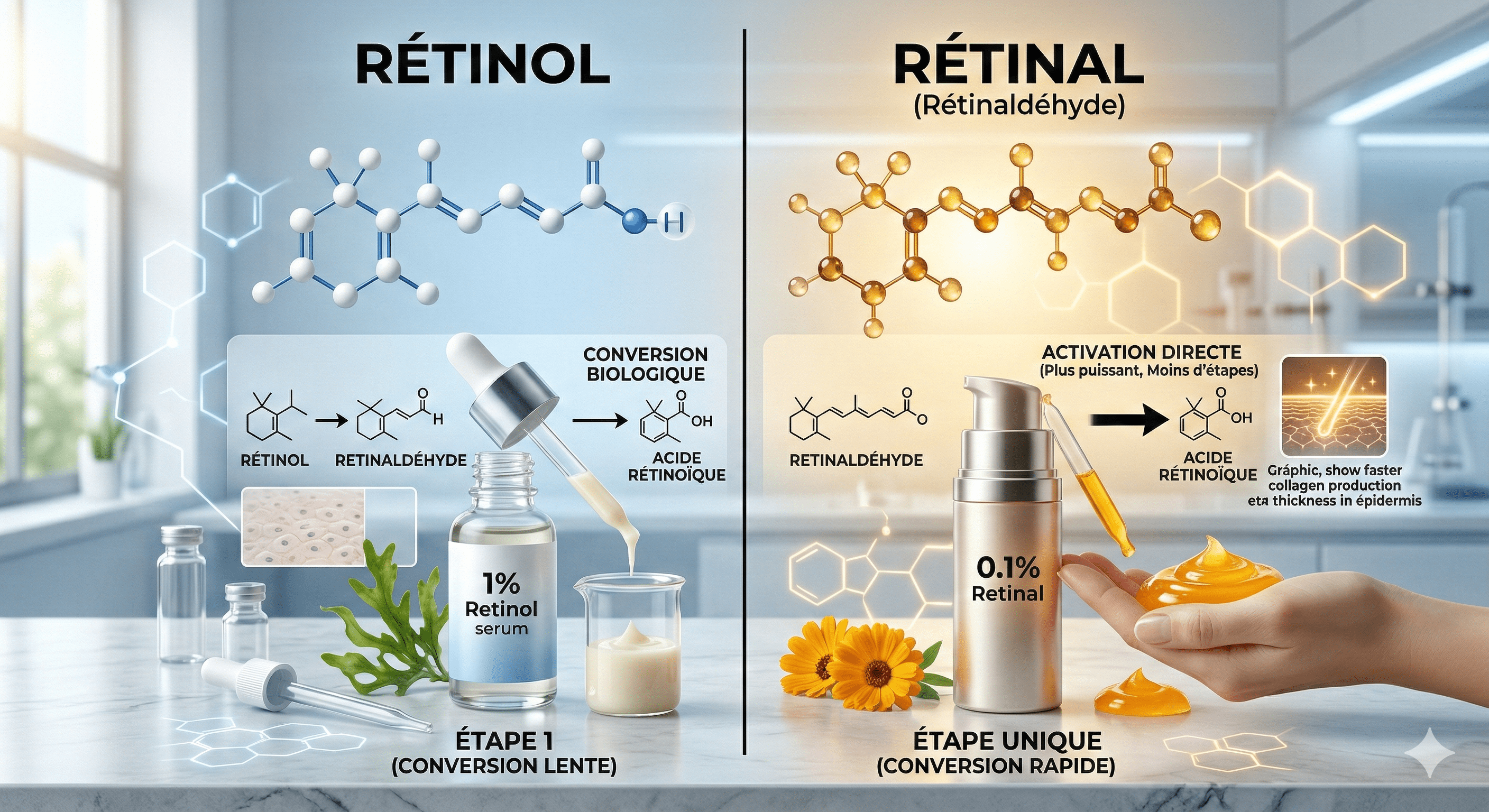
For the skin to be able to use vitamin A, it must be converted into retinoic acid , the only biologically active form capable of "dialoguing" with our cellular receptors.
The process follows this enzymatic pattern:
-
Retinol esters
-
Retinol
-
Retinaldehyde (Retinal)
-
Retinoic Acid
Why is Retinal gaining power?
Retinol requires two conversion steps to become active. In contrast, retinal is only one step away from retinoic acid. In biochemistry, the fewer steps involved, the more direct the delivery of energy to the tissues.
2. Performance Comparison
Retinol:
- Action speed: Slower (2-step conversion)
- Tolerance: Good, but may cause irritation depending on the dose
- Antibacterial activity: Low
- Stability: Unstable in air and light
Retinal:
- Speed of action: Up to 11 times faster than retinol
- Tolerance: Excellent, often better tolerated at equal efficacy
- Antibacterial action: High (ideal for acne-prone skin)
- Stability: Very unstable (requires encapsulation)
3. Focus on dark circles: Which one to choose?
The periorbital area (the contour of the eye) is 3 to 5 times thinner than the rest of the face.
-
Retinal for thickness: By stimulating collagen synthesis more rapidly, retinal helps to densify the dermis. This reduces the skin's transparency, which often reveals blood vessels (bluish circles under the eyes).
-
Managing irritation: Although more potent, retinal is paradoxically less irritating because it is metabolized by keratinocytes in a more controlled manner. This is a major advantage for dark circles.
4. Conclusion
If the While retinol remains the gold standard for its proven stability and affordability, retinal represents a superior technological advancement. It offers faster results on skin texture and wrinkles, while also possessing unique antibacterial properties that retinol lacks.
Formulation note: The performance of a retinoid depends heavily on its encapsulation system. A poorly formulated retinal will lose its benefits before it even reaches your skin.